
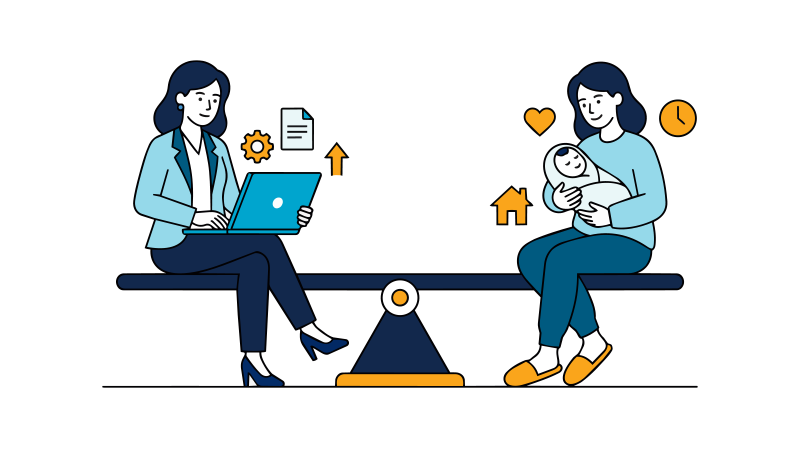
Becoming a mom changed the way I think about leadership, ownership, and the invisible work that keeps homes and law firms running.
It’s Monday. The alarm went off 30 minutes ago, and I have already run a marathon, mentally. The baby isn’t even awake yet.
Dawson moves up to a new classroom at daycare today. What did they say he needed again? I know he needs more diapers, but I definitely dropped off wipes on Friday. Don’t forget to give him his antibiotics before school for this ear infection. My husband leaves for a work trip today, which means I’m on both drop-off and pick-up duty this week. At what point am I squeezing in a grocery store run? Hopefully, dinner just speaks to me as I walk through Trader Joe’s, because I certainly don’t have a plan.
Then, there’s work.
I have three client calls back-to-back today, and I still need to prep for the last one. I need to follow up on the report I have out. Crap, I completely forgot to send Jon my availability. Sorry, Jon. That has to happen first thing. I also need to circle back with Stephanie on the PLAUD research, let Cristina know I returned something to Amazon so she’ll see a credit on the next company card statement, and I’m pretty sure there are three other things floating around in my head that I’ll remember at the absolute worst possible time.
By the time many of us “arrive” at work, whether physically or mentally, we have already been working for hours.
Some of the most exhausting work we do never appears on a calendar, a timesheet, or a task list. It is the remembering, anticipating, planning, checking, following up, and quietly making sure life keeps moving.
In parenthood, we have a name for it: the mental load.
Maybe you’re thinking, Okay, Kendall, what in the millennial nonsense is a “mental load”?
Fair question.
The mental load is not simply being busy or checking things off a list. It is remembering that the task exists in the first place. It is knowing when it needs to happen, anticipating what could go wrong, deciding who needs to handle it, following up to make sure it actually happened, and carrying the consequence when it does not.
Motherhood did not make me realize that everyone carries something. I already knew that. It made me realize how much invisible work keeps everything moving, both at home and inside your law firm. Once you become responsible for keeping one tiny human alive, you start noticing all the other people quietly keeping everyone else’s world from falling apart.
I have spent years helping law firms get their house in order. Ironically, becoming responsible for my own house taught me more about leadership than I expected.
At home, the visible task might be dropping Dawson off at daycare. The invisible work is reading the classroom email, knowing which supplies need to go with him, noticing that the diaper stash is low, remembering his medication, calculating travel time, and rearranging the rest of the day when drop-off takes longer than planned.
Law firms operate the same way.
A client receives a returned phone call. Behind it, someone remembered the client called after hours on Friday, noticed how anxious they sounded, reviewed the file before calling, anticipated the questions they would ask, decided whether the attorney might need to join, documented the conversation, and created the next task.
An attorney sees a settlement packet ready for review. Behind it, a paralegal tracked down records, followed up on missing bills, checked balances, resolved inconsistencies, organized the documents, and remembered the hundred small steps that stand between “we have a case” and “this is ready.”
An owner sees payroll processed, a new employee settling in, and a team lunch appearing on the calendar. Behind it, an office manager remembered deadlines, answered questions, coordinated access, anticipated what the new hire would need, noticed a morale issue, and quietly took care of details no one else knew existed.
That work is easy to miss precisely because a capable person keeps doing it.
In law firms, I have watched women become the unofficial keepers of things that never appear in a job description. She remembers everyone’s birthday because “she’s just good at that stuff.” She notices when someone seems off and checks in before anyone else does. She smooths over the awkward conversation, follows up on the thing everyone forgot, trains the new employee even though no one officially asked her to, and somehow always knows where that missing piece of information is.
None of it is formally assigned. It just becomes hers.
Because she is competent, dependable, and genuinely cares, people keep handing her more. She is the safe bet. She will remember. She will catch it. She will handle it.
Before long, she is not just doing her job. She is carrying pieces of everyone else’s too.
The funny thing about invisible work is that it is only invisible until it stops getting done. Suddenly the birthday cards are not signed, the new hire feels lost, the client falls through the cracks, and everyone asks, “Wait, who used to take care of that?”
Exactly.
Women often bear a disproportionate share of the mental load, juggling responsibilities at home and in the workplace. This mental load encompasses the invisible, non-physical tasks required to keep households and businesses running smoothly, such as scheduling appointments, remembering deadlines, coordinating logistics, and anticipating others' needs. At home, this often means managing childcare, meal planning, and household maintenance, even when both partners are employed full-time. At work, women are frequently expected to take on additional administrative or emotional labor—like mentoring colleagues, organizing celebrations, or mediating conflicts. These added layers of responsibility are rarely acknowledged, but significantly contribute to stress, burnout, and the ongoing challenge of balancing professional and personal lives. Addressing this imbalance is critical to achieving gender equity across all spheres.
Motherhood has taught me something uncomfortable: just because I can carry something does not mean I should own it forever. That is true at home. It is also true inside a law firm.
One of the quickest ways to burn out your highest performers is to confuse competence with ownership. Every time someone says, “Just ask Sarah; she knows,” you have learned something about Sarah, but you have also learned something about your operation.
You have learned that knowledge lives with a person instead of in the firm. You have learned that ownership is unclear. You have learned that the process probably depends on memory, availability, and goodwill. You have learned that if Sarah takes a vacation, gets sick, earns a promotion, or simply decides she cannot carry it anymore, the work may stop with her.
That is not stability. It is dependency.
If one paralegal is the only person who knows how settlement packets are prepared, the firm has a dependency. If one intake manager remembers every referral relationship, the firm has a dependency. If one office manager is carrying the culture, birthdays, onboarding, payroll reminders, vendor relationships, and everyone’s questions, the firm has a dependency, no matter how effortless she makes it look.
Strong operations do not ask one heroic person to keep everything together. They make the work visible, assign it intentionally, document what matters, and build enough shared knowledge that the organization can keep moving when life inevitably happens.
That does not mean every task must be divided equally. Equal and intentional are not the same thing. Healthy ownership means the right person knows what they own, has the authority and tools to own it, and is not quietly accumulating responsibilities simply because they once stepped in to help.
At home, if everything lives in my head, eventually something gets forgotten. The answer is not for me to become better at remembering an impossible number of things. The answer is to make the work visible, decide what actually matters, and share ownership.
Law firms are no different.
Maybe that is why motherhood has made me appreciate good operations even more. Before becoming a mom, I understood the business case for documented processes, clear workflows, cross-training, and defined roles. They improve consistency. They reduce errors. They make training easier. They help leaders see what is happening without chasing people for updates.
I still believe all of that.
But now I see something else: good operations are an act of care.
No SOP will fix a hard personal season. No dashboard will make daycare call less often. No workflow will remove the emotional weight of client work. Systems cannot make people less human, and they should not try.
What good operations can do is reduce the friction we unintentionally create for one another. They can separate necessary complexity from preventable chaos. They can preserve someone’s limited attention for the decisions, relationships, and judgment that actually require it. That is a much bigger purpose than keeping a binder of procedures on a shelf.
The goal is not to build a firm where no one is needed. It is to build a firm where no one person must be available, informed, and perfect at all times for everyone else to succeed.
Good systems matter because people are human. Good leadership begins from the same truth. There will be seasons when work needs more of us. There will be seasons when family does. There will be weeks when someone is running on less sleep, less energy, or less capacity than they would like to admit. Recognizing that is not the same as lowering the bar.
Grace is not ignoring missed deadlines, tolerating poor performance, or pretending problems do not exist. If anything, it requires a higher level of leadership, because it asks us to understand the problem before prescribing the solution.
The best leaders I have worked with pause before jumping to conclusions. Instead of asking, “Why didn’t this get done?” they ask, “What happened?”
Those questions sound similar, but they lead in different directions. One begins with blame. The other begins with information.
Sometimes expectations were not as clear as the leader thought. Sometimes priorities shifted, and no one recalibrated. Sometimes the training, time, or tools were missing. Sometimes ownership was never truly assigned. Sometimes a usually reliable employee is navigating a hard season that the firm cannot see.
Context does not eliminate accountability. It makes accountability more accurate.
When something slips, I still want to know whether the workflow was clear. I still want to know whether expectations were defined, whether the right person owned the work, and whether they had the tools and training to complete it.
But motherhood has added another question, one that does not appear in any operations manual I have ever written:
Who is quietly carrying this, and should they have to?
That question changes the conversation. It helps us see when a performance problem is really a process problem. It reveals when a “go-to person” has become a single point of failure. It exposes the cultural work that has been assigned by habit instead of choice. It reminds us that rewarding competence with endless responsibility is not recognition; sometimes, it is simply poor design.
And it gives leaders a chance to fix the system before the person holding it together finally sets it down.
Leadership is often described in terms of vision, courage, decisiveness, or influence. Those qualities matter. But much of leadership is quieter.
Tomorrow morning, my alarm will go off and, before Dawson even opens his eyes, my brain will probably run another marathon. I will think about daycare, work, dinner, the trip we have coming up, client calls, and whether I ever scheduled that dentist appointment. That is motherhood.
It has also made me a better consultant because it changed the questions I ask. I still ask whether the workflow is clear. I still ask whether expectations are defined. I still ask whether the right person owns the work. But now I also ask who is quietly holding everything together, and whether the firm has mistaken that person’s strength for a sustainable system. Because whether it is my house or a law firm, I have learned the same lesson: The healthiest systems are not the ones where one person somehow keeps everything together. They are the ones where no one has to.